|
The Formal Place Setting
There is general agreement among etiquette experts and writers of etiquette manuals that far too many people are not sure they can choose the proper flatware for the appropriate course of the meal. As all published text tells you, use the outermost flatware as necessary, one set for each course, and you will not make a mistake unless the table has been improperly set to start with.
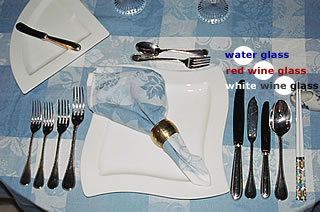
For a formal place setting, you will receive exactly the flatware you will need, arranged in the correct order. Good etiquette requires you to assume that the host has correctly designated each piece of flatware to its task. As each course is finished, the corresponding flatware (used and unused) will be removed with the dish, leaving you ready for the next course to arrive. If the meal is to have more than three or four courses, common sense and aesthetics tell you not to place a slew of forks and knives at the sides of the charger/service plate, so on these occasions the proper new flatware will be brought to you with each course after all of the original settings have been used.
A service plate, also known as a charger plate is never eaten from. It will either be removed when the first course is brought, or the different courses will be set on top of it. A set table may contain any or all of the flatware below.
Oyster Fork
There is a small fork provided for eating oysters. It will be to your right. They say every rule has an exception and this is the one exception to the rule of placing forks to the left of the plate.
Soup Spoon
The soup spoon will be located to the right of the plate. It is usually the only spoon provided with the initial place setting.
Salad Fork and Knife
The salad fork may have a thicker tine at the left of the fork. For right handed people, which are the majority, this strengthens the fork for use in cutting large greens without having to use the salad knife.
Fish Fork and Knife
Both a special fork and a knife should be provided for fish. In the old days, the fish knife often had a silver blade, because fish, which is often served with lemon, reacts with the steel in old knife blades, causing an unpleasant taste. The invention of stainless steel in the 1920s took care of this problem. The fish fork is usually shorter than the meat fork.
Meat Fork and Knife
In the western hemisphere, the innermost fork and knife are provided for the meat course of the meal. In some countries where they eat the salad after the main course, the innermost fork and knife are for the salad and are always smaller than the meat fork and knife.
Dessert Spoon and Fork
The dessert spoon and/or fork may be set when you arrive, or may be brought in with the dessert. If they are part of the initial place setting, they would be placed horizontally north of the plate, parallel to each other, with the fork closest to the plate and the tines of the fork pointing right. The bowl of the spoon should point to the left.
Teaspoon
When coffee and tea are served, a teaspoon will be provided and it is brought in on the saucer next to the cup.
Butter Knife
If a bread plate is provided, as in the photo to the left, a butter knife will also be provided. Remember this is only for the butter as bread is never cut with that or any knife, but simply ripped apart.
Chopsticks
In today's eclectic cuisine, your dinner may include one or several oriental courses. If so, chopsticks may be provided for your convenience, such as with nigiri sushi or rolls. Chopsticks may be used for more than one course.
What is the difference between Private Chefs and Personal Chefs?
|